life: acoustic & amplified
poetry, quotes & thoughts about life
Archive for the month “July, 2012”
Who is my neighbor?
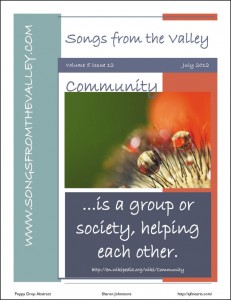 “Love your neighbour as yourself” the Gospel says (Matthew 22:38). But who is my neighbor? We often respond to that question by saying: “My neighbours are all the people I am living with on this earth, especially the sick, the hungry, the dying, and all who are in need.” But this is not what Jesus says. When Jesus tells the story of the good Samaritan (see Luke 10:29-37) to answer the question “Who is my neighbour?” he ends the by asking: “Which, … do you think, proved himself a neighbor to the man who fell into the bandits’ hands?” The neighbour, Jesus makes clear, is not the poor man laying on the side of the street, stripped, beaten, and half dead, but the Samaritan who crossed the road, “bandaged his wounds, pouring oil and wine on them, … lifted him onto his own mount and took him to an inn and looked after him.” My neighbour is the one who crosses the road for me!
– Henri Nouwen
http://www.henrinouwen.org/
;
Last week Ann Voskamp, and her son Caleb, were in Haiti for Compassion http://www.compassion.ca/child_list.asp read her blog posts about this experience http://www.aholyexperience.com/ – if you are not moved to action, you must be dead!
Check out the newest issue of my newsletter at www.songsfromthevalley.com – it is a very personal one. At the preent moment, I am in the middle of a big faith walk, so please pray for me today as God calls me to your mind.
I read Martin Luther King, Jr’s Letter from a Birmingham Jail yesterday and one sentence especially jumped out at me – ‘Actually, time itself is neutral; it can be used either destructively or constructively.’
What are we going to do with our time here? It is always our choice!
Wildflowers
 Dark and early in your story someone fearful
of your inborn glory took it
and buried it behind your house,
and you, innocently, and wise to save yourself
from their greater wrath,
believed its absence.
It’s not a pompous glory,
insistent on regard, but sure and quiet
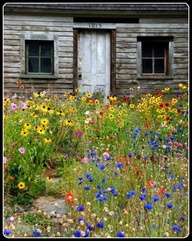 as a wildflower’s, asking nothing.
And so you’ve lived—so have we all—
without it, your heart shoveled over
with self-doubt and apology, as if
you have no place or voice here
among angels.
We see you in the cripples who flocked
to Jesus, the mute, the paralyzed,
 bent over, shut out, gone mad.
And all he meant to say was this:
you shine. You bring a gift
as no one else, and you belong.
Your Word deserves a hearing,
and this world needs your beauty
and your grace. There is no rank
you fall below, no worth you fail to match.
 Your shuttering was evil, and God
wants it undone, and wants you whole.
And so she takes you by the hand
and raises you to stand, to walk, to speak.
She listens to your song with joy.
She rains upon the earth
until you are unafraid of your radiance
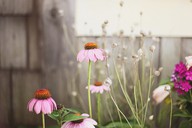
and all our houses are surrounded by wildflowers.
______________________
Steve Garnaas-Holmes
Unfolding Light
www.unfoldinglight.net
Our deepest fear is not that we are inadequate. Our deepest fear is that we are powerful beyond measure. It is our light, not our darkness that most frightens us. We ask ourselves, Who am I to be brilliant, gorgeou s, talented, fabulous? Actually, who are you not to be? You are a child of God. Your playing small does not serve the world. There is nothing enlightened about shrinking so that other people won’t feel insecure around you. We are all meant to shine, as children do. We were born to make manifest the glory of God that is within us. It’s not just in some of us; it’s in everyone. And as we let our own light shine, we unconsciously give other people permission to do the same. As we are liberated from our own fear, our presence automatically liberates others. – Marianne Williamson
We are what we continually do – Aristotle
Habits Die Hard
I am your constant companion.
I am your greatest asset or heaviest burden.
I will push you up to success or down to disappointment.
I am at your command.
Half the things you do might just as well be turned over to me.
For I can do them quickly, correctly, and profitably.
I am easily managed; just be firm with me.
Those who are great, I have made great.
Those who are failures, I have made failures.
I am not a machine, though I work with the precision of a
machine and the intelligence of a person.
You can run me for profit, or you can run me for ruin.
Show me how you want it done. Educate me. Train me.
Lead me. Reward me.
And I will then…do it automatically.
I am your servant.
Who am I?
I am a habit.
by Mac Anderson & John J. Murphy / simpletruths.com
Stephen Covey, 7 Habits of Highly Effective People. Rest in peace.
Habit 1: Be Proactive
Take initiative in life by realizing that your decisions (and how they align with life’s principles) 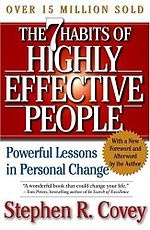 are the primary determining factor for effectiveness in your life. Take responsibility for your choices and the consequences that follow.
Habit 2: Begin with the End in Mind
Self-discover and clarify your deeply important character values and life goals. Envision the ideal characteristics for each of your various roles and relationships in life.
Habit 3: Put First Things First
Prioritize, plan, and execute your week’s tasks based on importance rather than urgency. Evaluate whether your efforts exemplify your desired character values, propel you toward goals, and enrich the roles and relationships that were elaborated in Habit 2.
Habit 4: Think Win-Win
Genuinely strive for mutually beneficial solutions or agreements in your relationships. Value and respect people by understanding a “win” for all is ultimately a better long-term resolution than if only one person in the situation had gotten his way.
Habit 5: Seek First to Understand, Then to be Understood
Use empathic listening to be genuinely influenced by a person, which compels them to reciprocate the listening and take an open mind to being influenced by you. This creates an atmosphere of caring, respect, and positive problem solving.
Habit 6: Synergize
Combine the strengths of people through positive teamwork, so as to achieve goals no one person could have done alone. Get the best performance out of a group of people through encouraging meaningful contribution, and modeling inspirational and supportive leadership.
Habit 7: Sharpen the Saw
Balance and renew your resources, energy, and health to create a sustainable, long-term, effective lifestyle. It primarily emphasizes on exercise for physical renewal, prayer (mediation, yoga, etc.) and good reading for mental renewal. It also mentions service to the society for spiritual renewal.
7 Habits – repost from http://thedailylove.com/
be still and know…

Just found these comics thanks to my new friend Rex Lai! Awesome stuff!!! Love it!!!
This is a little about the creator of these amazing comics –
Hi! My name is Leah. I live in San Francisco, CA. I started drawing comics in 2010 when i ran out of words but still had something to say.
The name DharmaComics is a double entendre. “Dharma”, a sanskrit word, has many translations. One of which is “Truth” – but rather than an objective truth, it refers to the truth inside each of us, our personal compass, guide, knowing.
Another is “Nature”, as in, our individual nature, that which we were born to be and do. The example is often given of an acorn, who’s dharma is to grow into an oak tree; and not just any oak tree, but the specific one it becomes.
To me “Dharma Comics” refers both to my quest to reflect deep personal truthfulness, and also, i experience these comics as something i am meant to do. I don’t have to believe in some big master plan, i know because like the acorn into the oak, they come naturally.
Fill my cup, Lord

Anyone who stops learning is old, whether at twenty or eighty. Anyone who keeps learning stays young. The greatest thing in life is to keep your mind young. – Henry Ford
;
I am emptied out that I might learn new things. I step into the void of this space with the same faith it took for Abraham to leave Ur, for Moses to part the waters, for Joshua to march around the walls seven days, then seven times. The same faith it took for Gideon to take his 300 and blow the trumpets. I am in very good company, and have been learning this way for 22 years now – just a tiny grain of sand in the hour glass of time and the baton of faith. Pretty good stuff!

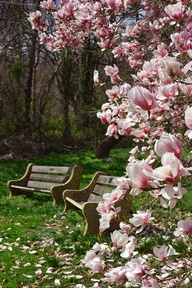
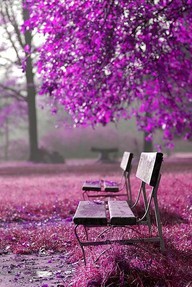
friends with benches

Benches are special things aren’t they?

They themselves sit and rest, in the sun, in the shade, in the rain, in the snow, at three in the morning…
there to welcome whoever might pass by.
And for what purpose?

To give a soul a moment to rest, to look out, to think, to plan something, or to get over something.
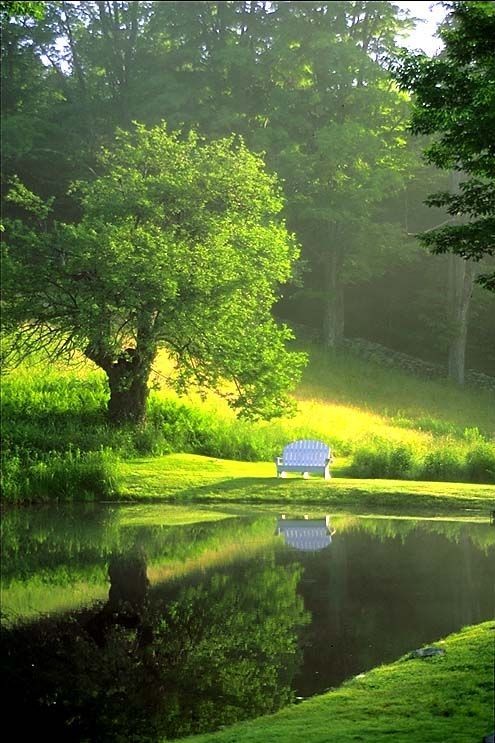
And in their most special times, most special for these benches, are when two people meet and share themselves. Communicate and think more completely than they could or would if they were still walking.

Then after minutes or hours the people rise.
They are different forever because of those minutes, or hours.
Different in very minor ways most times I’m sure.
And at other times, profoundly changed.

They look back and the bench seems physically unchanged, but we know otherwise.
A person was there, moments after measurable warmth remains,
albeit slowly spreading out to be no longer measurable.
The world is different.
Relationships,
interconnections,
changes in perspective.
A reaffrimation of love in the broadest sense.

That maybe god did not make man in his image. That maybe man arrogantly makes god in his image.
God did not make only man,
and I don’t think everything else was made for only for man’s purpose.
Maybe what we find so beautiful and comforting is that nature,
the cosmos,
god,
free will,
the opportunities to do good or ignore other’s needs,
the choices to try and give more than we take,
or take all we can,
the always present capability to pursue happiness…

are all here as are we,
with a purpose we will always look for,
and never completely find,
and all of it as part of a whole incomprehensible to us.
Such joy possible just knowing we are so fortunate to be part of it.

God has no limits, none whatsoever.

On a bench,
realizing we are part of it all,
and always will be,
and sharing
that there is no necessity to understand it all.
– Sunny
Nine steps to transform yourself into a river
 by Paulo Coelho on July 11, 2012
http://paulocoelhoblog.com/2012/07/11/be-like-a-river/
“A river never passes the same place twice,” says a philosopher. “Life is like a river,” says another philosopher, and we draw the conclusion that this is the metaphor that comes closest to the meaning of life. Consequently, it is always good to remember::
A] We are always doing things for the first time.While we move between our source (birth) to our destination (death), the landscape will always be new. We should face these novelties with joy, not with fear – because it is useless to fear what cannot be avoided. A river never stops running.
B] In a valley we walk slower. When everything around us becomes easier, the waters grow calm, we become more open, fuller and more generous.
C] Our banks are always fertile. Vegetation only grows where there is water. Whoever comes into contact with us needs to understand that we are there to give the thirsty something to drink.
D] Stones should be avoided. It is obvious that water is stronger than granite, but it takes time for this to happen. It is no good letting yourself be overcome by stronger obstacles, or trying to fight against them – that is a useless waste of energy. It is best to understand where the way out is, and then move forward.
E] Hollows call for patience. All of a sudden the river enters a sort of hole and stops running as joyfully as before. At such moments the only way out is to count on the help of time. When the right moment comes the hollow fills up and the water can flow ahead. In the place of the ugly, lifeless hole there now stands a lake that others can contemplate with joy.
F] We are one. We were born in a place that was meant for us, which will always keep us supplied with enough water so that when confronted with obstacles or depression we have the necessary patience or strength to move forward. We begin our course in a soft and fragile manner, where even a simple leaf can stop us. Nevertheless, as we respect the mystery of the source that gave us life, and trust in His eternal wisdom, little by little we gain all that we need to pursue our path.
G] Although we are one, soon we shall be many. As we travel on, the waters of other springs come closer, because that is the best path to follow. Then we are no longer just one, but many – and there comes a moment when we feel lost. However, as the Bible says, “all rivers flow to the sea.” It is impossible to remain in our solitude, no matter how romantic that may seem. When we accept the inevitable encounter with other springs, we eventually understand that this makes us much stronger, we get around obstacles or fill in the hollows in far less time and with greater ease.
H] We are a means of transportation. Of leaves, boats, ideas. May our waters always be generous, may be always be able to carry ahead everything or everyone that needs our help.
I] We are a source of inspiration. And so, let us leave the final words to the Brazilian poet, Manuel Bandeira:
“To be like a river that flows silent through the night, not fearing the darkness and reflecting any stars high in the sky.
And if the sky is filled with clouds, the clouds are water like the river, so without remorse reflect them too”
 life: acoustic & amplified